
Seas the Opportunity: How Seaweed Is Shaping Coastal Futures
-
Coastal resilience
-
Coastal wetland conservation
-
Vibrant Coasts and Deltas
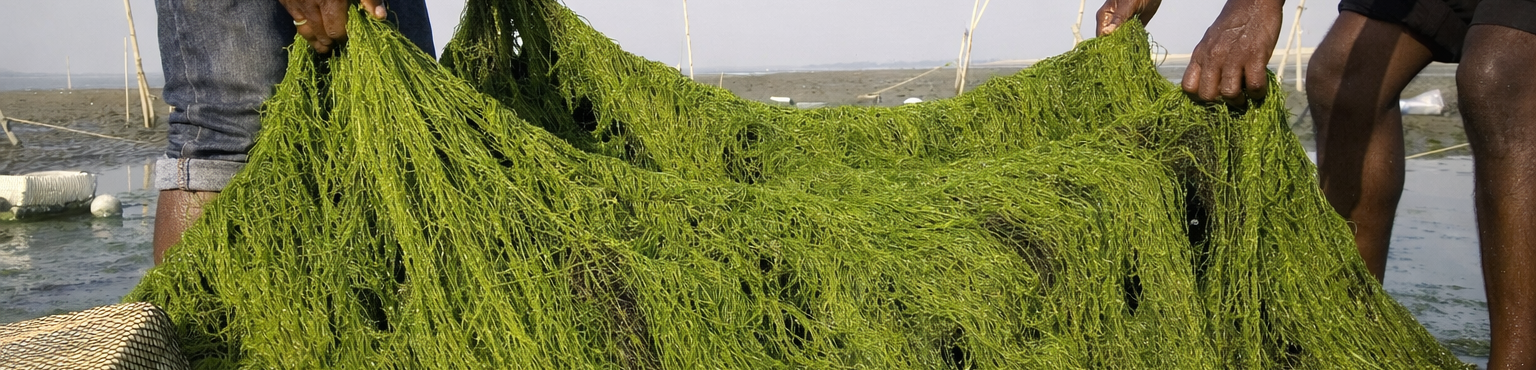
At low tide along Tanzania’s coast, the ocean retreats just enough to reveal what lies beneath the surface. Thin lines stretch across the shallow water, anchored carefully in place. Farmers step into the sea, moving slowly and deliberately as they tend to the seaweed tied along each rope. This is daily life in parts of Bagamoyo and Kilwa.
For decades, seaweed farming has been a steady source of income for coastal communities, particularly for women who make up the majority of farmers. It is work shaped by the rhythm of the tides, requiring patience, consistency, and an intimate understanding of the ocean. What appears simple from a distance is, in reality, deeply connected to both livelihoods and the health of marine ecosystems.
Seaweed is one of the few resources that offers both. As it grows, it absorbs nutrients from the water and captures carbon, contributing to healthier marine environments. At the same time, it provides income in regions where options can be limited, helping households meet daily needs and adapt to changes in traditional livelihoods such as fishing.
But along this coastline, the conditions that support this work are shifting. Rising ocean temperatures are affecting yields. In some areas, unsuitable farming locations and unsustainable practices have placed pressure on ecosystems such as seagrass meadows. Beyond the water, challenges continue after harvest. Much of the seaweed is sold in its raw form, with limited processing or value addition, meaning that farmers often earn only a fraction of its potential market value.
These challenges are not isolated. They are part of a broader system. Seaweed farming is connected to a wider value chain that includes production, processing, packaging, transport, markets, and policy. Weakness in any part of this chain can limit the benefits for those at the very beginning of it. Improving outcomes therefore requires more than changes in farming techniques. It calls for a deeper understanding of how the entire system functions.
This is where the Sustainable Seaweed Project comes in. With support from the Embassy of the Netherlands, Wetlands International Eastern Africa is working in Bagamoyo and Kilwa to strengthen seaweed farming through a combination of local action and national level engagement. The project recognises that improving livelihoods and building resilience requires both practical support on the ground and stronger systems that enable the sector to grow.
A key part of the project is understanding the value chain in detail. Through a comprehensive assessment, the project examines how seaweed is produced, processed, and marketed. It looks at farming practices, site conditions, species selection, and post-harvest handling, while also exploring how seaweed is dried, packaged, and sold. It considers who is involved at each stage, from farmers and cooperatives to traders, processors, financial institutions, and local authorities. This process helps to identify where value is lost, where opportunities exist, and how the system can work better for the people within it.
At the same time, the project places strong emphasis on capacity building. Through district level engagements, including workshops and training sessions, farmers and other stakeholders are supported to strengthen sustainable farming practices, improve environmental management, and better understand climate adaptation strategies. There is also a focus on financial literacy, market access, and business development, helping farmers move beyond subsistence towards more stable and profitable livelihoods.
Inclusion is central to this work. Women remain the backbone of the sector, yet access to resources, finance, and decision making opportunities is not always equal. The project actively seeks to create space for women, youth, and persons with disabilities to participate meaningfully, ensuring that the benefits of the sector are more widely shared.
Environmental sustainability is equally important. Seaweed farming has the potential to support climate resilience and improve marine ecosystems, but only when it is done responsibly. The project promotes better site selection, sustainable harvesting, and practices that reduce pressure on sensitive habitats such as seagrass beds, recognising that healthy ecosystems are essential for long term livelihoods.
Another important element is translating knowledge into action. Findings from the field are being shaped into practical outputs that serve different audiences. A white paper is being developed to inform policy and investment decisions, providing clear recommendations on how to strengthen the sector. At the same time, a Swahili handbook is being prepared to offer accessible, practical guidance for farmers and cooperatives, ensuring that knowledge can be applied in everyday work.
By connecting local realities with policy dialogue, the project aims to bridge a gap that often exists between practice and decision making.
Along the coast, however, much of this transformation remains subtle. The tide still comes in and out. Farmers return to the water each day. Seaweed is tied, checked, harvested, and laid out to dry under the sun. These routines continue, largely unchanged on the surface.
But within them, something is evolving. A more connected, informed, and inclusive approach to seaweed farming is taking shape. One that recognises it not just as an activity in the water, but as part of a larger system linking people, ecosystems, and economies.
And in that space, between the pull of the tide and the resilience of the communities who depend on it, lies the potential for something more enduring.
Not just survival, but a pathway toward a more sustainable coastal future.